Candidates should have a level 5 qualification (typically, HND or Foundation Degree) in a subject closely related to their intended pathway.
It is normally a requirement that: HNDs were passed with an overall Merit, or Foundation Degrees have an overall average mark of 50% or higher All mathematics modules within students’ level 4 and 5 studies were passed.Students offering different qualifications, or with lesser grades than stated above are welcome to apply and will be considered through our Non-Standard Entry processes.
Start date:
Sep 2026
Course Overview
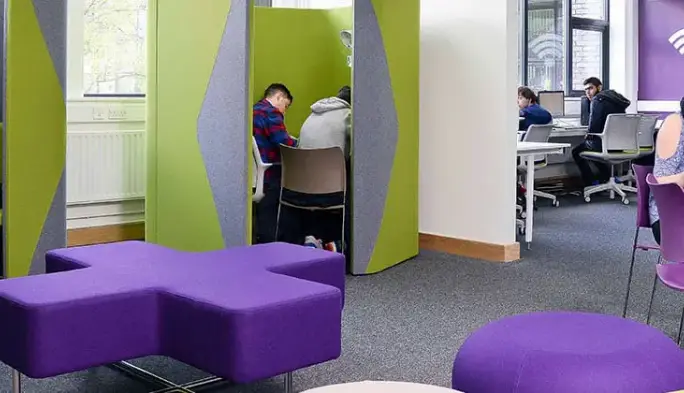
As a BEng Electrical and Electronic Engineering student, you will study within our dedicated University Centre and specialist engineering facilities. These include fully equipped engineering laboratories, CAD suites, and workshops, giving you practical experience in electrical and electronic systems.
Our facilities are developed with employer input to reflect current industry practice, providing access to advanced tools, simulation software, and renewable energy technologies. The Learning Resource Centre enhances your studies with specialist texts, journals, and databases, supported by expert staff to strengthen your academic and research skills.
Course Overview
Modules : Individual Major Project – The module requires students to manage and deliver a professional?standard engineering project that synthesises prior learning, addresses an approved real?world problem aligned with their target award, develops new skills beyond the taught syllabus, produces an evaluable solution or artefact, and includes an assessment of the project’s commercial potential. Engineering mathematics and computation – The module extends the mathematics covered in earlier Higher National Diploma study by introducing additional engineering?focused topics useful at level 6 and for future progression, while also teaching students to use industry?standard software to model and solve engineering problems. Engineering Systems Design and Simulation – The module develops a systems-based approach to analysing and designing complex electrical or mechanical systems – using case studies that include unfamiliar, interrelated subsystems – and builds advanced modelling skills that allow these real systems to be simulated with greater accuracy, with the modelling work based on the same systems explored in the analytical component. Engineering Innovation – The module is designed to develop an understanding of innovation, creativity and problem solving as core requirements for business success in a globalised economy, and to provide students with the knowledge and skills required for successful exploitation of new ideas. Microprocessor Applications – The module equips students with an understanding of microprocessor?based systems, practical experience in developing microprocessor solutions for real engineering problems, and the ability to critically assess which microprocessors or system designs are most suitable for specific engineering scenarios.
Additional Information
Strong University Partnership – This degree is validated by Liverpool John Moores University. Specialist Facilities – Access purpose-built learning environments including counselling pods, a VR suite, and a dedicated University Centre. Proven Success – Students achieve some of the highest satisfaction and progression rates in the region, moving into employment or postgraduate study. Financial and Practical Help – From bursaries and equipment loans to free breakfast and gym access, we provide wide-ranging support to help you succeed.
This programme is validated by Liverpool John Moores University. Upon completion of the programme, one certificate will be issued by LJMU. Upon completion of the programme, a graduation ceremony will be arranged by East Lancashire UC. Learn more about this course in the LJMU Course Catalogue: https://coursecatalogue.ljmu.ac.uk/programme/2025/36970
The fees for our courses are: • Full time – £9,525 per year • Part Time – £4,763 per year The course fees are payable to East Lancashire Learning Group.
How is the course delivered?
Teaching combines lectures, seminars, workshops, and laboratory sessions with guided independent study. Advanced concepts are introduced through lectures, while practical sessions and labs allow you to apply knowledge using industry-standard equipment and digital technologies.
Project-based assignments and group work reflect real-world manufacturing challenges, encouraging collaboration, leadership, and innovation. Tutorials and feedback sessions provide individual support, while independent research develops critical analysis and technical expertise.
How my learning will be assessed?
Reports and essays – critically evaluating electrical and electronic concepts. Project-based assignments and case studies – applying theory to engineering challenges. Laboratory and workshop assessments – demonstrating technical and practical competence. Presentations and professional discussions – developing confidence in communication and leadership.Examinations – testing knowledge of specialist topics. Independent Major Project – producing a substantial research-based study in your chosen area. Examinations – testing knowledge of core and specialist topics.
Course Facilities
As a BEng Electrical and Electronic Engineering student, you will study within our dedicated University Centre and specialist engineering facilities. These include fully equipped engineering laboratories, CAD suites, and workshops, giving you practical experience in electrical and electronic systems.
Our facilities are developed with employer input to reflect current industry practice, providing access to advanced tools, simulation software, and renewable energy technologies. The Learning Resource Centre enhances your studies with specialist texts, journals, and databases, supported by expert staff to strengthen your academic and research skills.
Potential Careers
Graduates of the BEng (Hons) Engineering (Electrical and Electronic) are well-prepared for advanced roles in technical and professional fields. Career opportunities include Electrical Engineer, Electronics Engineer, Control Systems Engineer, Power Engineer, or Instrumentation Engineer, with employment across aerospace, automotive, energy, communications, and manufacturing.
Qualified engineers are highly sought after for their rigorous approach to problem-solving, with further opportunities available in technical sales, consultancy, design and development, commissioning, and research. The programme also provides a platform for postgraduate study or routes towards Chartered Engineer (CEng) status.